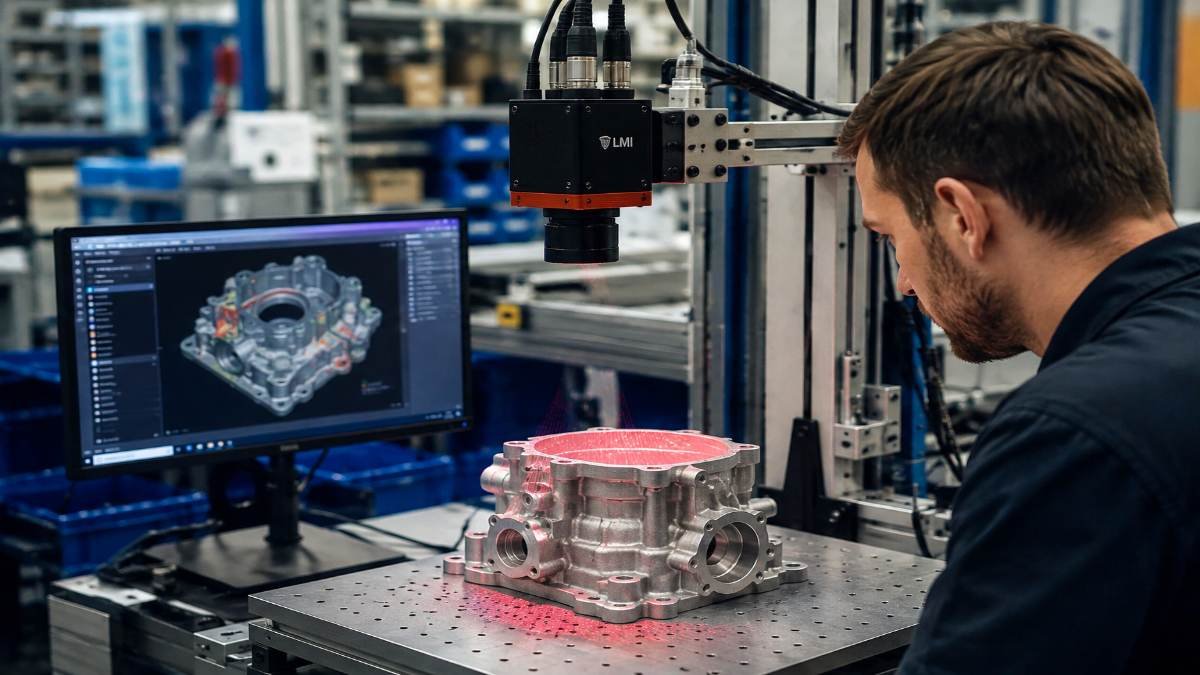
A conventional camera can tell an automated system what an object looks like. A 3D machine vision system can go further by providing information about its shape, height, depth, position, and spatial relationship to other objects.
That difference becomes important when a manufacturing or automation task depends on more than color, contrast, or a flat image. A robot picking parts from a bin, for example, needs to understand where an object is located in three-dimensional space. Similarly, an inspection system may need to determine whether a surface has the correct height or whether a component is positioned correctly.
The advantages of 3D machine vision systems come largely from this additional depth information. They can support dimensional inspection, robot guidance, object detection, automated handling, quality control, and other manufacturing tasks where 2D images may not provide enough information.
NIST has identified 3D imaging as an important area for manufacturing automation and robotic perception, including applications involving part localization, recognition, capture, and assembly.
What Is a 3D Machine Vision System?
A 3D machine vision system uses cameras, sensors, illumination, and software to capture information about an object’s three-dimensional structure.
Instead of producing only a flat image, the system creates or analyzes depth information. Depending on the technology, this may allow the system to determine the height, distance, shape, position, or surface profile of an object.
Common approaches to 3D imaging include technologies such as:
- Structured light
- Laser-based 3D sensing
- Stereo vision
- Time-of-flight sensing
- Other depth-sensing techniques
The exact technology used depends on the application, required accuracy, object characteristics, working distance, speed, and environmental conditions.
A 3D vision system can then use the captured data for tasks such as inspection, measurement, object localization, robot guidance, and automated handling.
This makes 3D vision particularly useful when the physical shape or position of an object matters.
Main Advantages of 3D Machine Vision Systems
1. Captures Depth and Height Information
One of the biggest advantages of 3D machine vision is its ability to capture depth.
A standard 2D image can show where an object appears on the image plane, but it does not inherently provide complete information about how far that object is from the camera or how its surface changes in depth.
3D vision adds another layer of information.
For example, two components may look almost identical from a 2D perspective but have different heights or positions. A 3D system can use depth information to distinguish between them.
This can be useful when an application needs to determine:
- Object height
- Distance from the sensor
- Surface position
- Object orientation
- Relative position between components
- Changes in three-dimensional shape
This additional information is one reason 3D imaging has become relevant to robotics, manufacturing inspection, and automated processes.
2. Improves Dimensional Inspection
Manufacturers often need to verify whether a part has the expected dimensions or geometry.
3D machine vision can help inspect characteristics such as height, depth, profile, surface position, and overall geometry.
For example, an automated inspection system could check whether:
- A component is sitting at the correct height
- A manufactured part has the expected profile
- A deposited material has the required thickness
- A product is assembled correctly
- A surface contains an unwanted deformation
The exact measurement capability depends on the sensor, calibration, resolution, optics, software, and application setup.
NIST research on manufacturing inspection describes dimensional inspection as a process of verifying the geometry of manufactured parts against specified geometry or models.
The practical benefit is that dimensional checks can become part of an automated production process rather than requiring every item to be manually measured.
3. Handles Complex Object Shapes Better
Some objects cannot be reliably evaluated from a flat image.
A part may have curves, raised sections, holes, uneven surfaces, or multiple height levels. A 2D camera may detect the object’s outline or visible features, but it may struggle to understand the complete three-dimensional structure.
3D vision can provide information about those physical variations.
This is particularly useful for applications where shape matters as much as appearance.
For example, a system could distinguish between two parts that have similar colors and patterns but different physical shapes.
The important point is that 3D vision does not simply provide a higher-quality photograph. Its value comes from measuring or interpreting spatial information.
4. Improves Robot Guidance
Robots need accurate information about the position and orientation of objects before they can reliably pick, place, assemble, or manipulate them.
This is one of the strongest applications for 3D machine vision.
A 3D vision system can help determine where an object is located and how it is oriented in three-dimensional space. The resulting information can then be used by a robot or automation system.
For example, a robot may need to pick a component that is lying at an angle inside a container. A 2D image can provide useful positional information, but the robot may also need height and orientation data to approach the component correctly.
3D vision-guided robotics is used for applications such as assembly, machine tending, and depalletizing.
5. Supports Automated Bin Picking
Bin picking is a common automation challenge.
Imagine a container filled with randomly positioned components. A robot needs to identify one suitable part, determine its location and orientation, pick it without hitting surrounding objects, and move it to the next stage.
This is difficult when the system only has a flat image.
3D vision can provide information about the height and spatial arrangement of the objects. That helps the automation system identify individual pieces and determine possible picking positions.
NIST has specifically identified 3D perception for areas including part localization, part recognition, part capture, and robotic assembly.
The result can be a more flexible automated process for handling parts that are not already arranged in perfectly controlled positions.
6. Helps Detect Shape and Surface Defects
Not every manufacturing defect is primarily a color or pattern problem.
Some defects change the physical shape of a product.
Examples may include:
- Dents
- Raised areas
- Depressions
- Incorrect profiles
- Missing material
- Excess material
- Uneven surfaces
- Incorrect assembly height
A 3D vision system can analyze depth or surface information to identify these types of variations.
That does not mean every 3D system can automatically detect every defect. Detection depends on the sensor’s resolution, field of view, calibration, software, lighting, material characteristics, and inspection requirements.
Still, when the defect itself is three-dimensional, having three-dimensional data can make the inspection problem much easier to address.
7. Reduces Dependence on Manual Inspection
Manual inspection can be useful, particularly for complex or low-volume products. However, repetitive inspection tasks can consume significant operator time.
Machine vision allows suitable inspection tasks to be integrated into an automated production process.
For example, instead of asking an operator to repeatedly check whether components are positioned correctly, a vision system may perform a predefined inspection and send the result to the production system.
NIST’s manufacturing automation resources identify automated visual inspection as an application of machine vision and describe automation as a way to improve consistency and shift human effort toward higher-value activities.
The goal is not necessarily to eliminate people from the process. In many cases, the better objective is to let people focus on decisions and tasks that require judgment while automation handles repetitive measurements or inspections.
8. Provides More Consistent Inspection Results
Human inspectors can become tired, distracted, or inconsistent when performing repetitive visual checks.
An appropriately designed machine vision system can apply the same programmed inspection criteria repeatedly.
This can improve consistency, particularly when the inspection is based on measurable characteristics such as dimensions, position, height, or surface profile.
However, consistency depends on the complete system—not only the camera.
Calibration, sensor positioning, lighting, software settings, environmental conditions, and maintenance can all influence performance.
A well-designed 3D vision application therefore requires more than simply installing a 3D camera.
9. Supports Faster Production Decisions
Machine vision can provide inspection information directly within an automated process.
Instead of inspecting a product later, a system can potentially evaluate it while it is moving through production.
Depending on the application, the result may be used to:
- Accept or reject a part
- Trigger a robot
- Redirect a product
- Stop a process
- Adjust equipment
- Record inspection information
- Identify an object for the next production stage
The speed achievable depends heavily on the sensor, processing hardware, software, object movement, image complexity, and required accuracy.
This makes system design important. A highly accurate sensor is not automatically the best choice if it cannot meet the required production cycle time.
10. Works Well With Manufacturing Automation
3D machine vision becomes particularly valuable when it is integrated with other automation technologies.
A typical automated system might combine:
3D sensor → vision software → decision → robot or machine → production result
For example:
- A sensor captures a 3D image.
- Software processes the depth information.
- The system identifies an object or checks its dimensions.
- A controller receives the result.
- A robot performs the required action.
- The process continues automatically.
This type of integration supports applications such as robotic assembly, machine tending, material handling, inspection, and depalletizing.
NIST notes that advances in sensors, software, vision systems, and related technologies are helping make manufacturing automation accessible across different sizes of manufacturers.
3D Machine Vision vs. 2D Machine Vision
The difference between 2D and 3D vision is easiest to understand by looking at the type of information each system provides.
| Feature | 2D Machine Vision | 3D Machine Vision |
| Basic image | Yes | Yes, depending on system |
| Color information | Often available | Often available |
| Object position in image | Yes | Yes |
| Depth information | Limited or unavailable | Yes |
| Height measurement | Limited | Stronger capability |
| Surface profile | Limited | Stronger capability |
| Robot guidance | Possible | Particularly useful |
| Bin picking | More challenging | Well suited |
| Flat visual inspection | Excellent use case | Can be used |
| Three-dimensional measurement | Limited | Stronger capability |
| System complexity | Often lower | Often higher |
| Cost | Can be lower | Can be higher |
This does not mean that 3D vision is always better than 2D vision.
If an application only requires checking whether a label is present, reading a code, or detecting a simple visual feature, a 2D system may be more practical.
3D becomes valuable when depth, height, shape, or spatial positioning is part of the problem.
Where Are 3D Machine Vision Systems Used?
3D machine vision has applications across several industries.
Automotive Manufacturing
Automotive production involves complex components, automated assembly, robotic handling, and dimensional inspection.
3D vision can support tasks such as:
- Part positioning
- Robot guidance
- Component inspection
- Assembly verification
- Surface and profile measurement
Electronics Manufacturing
Small components often require precise positioning and inspection.
Depending on the application, 3D vision can help analyze component height, placement, and physical geometry.
Packaging
Packaging automation can involve products arriving in different positions or orientations.
3D vision can help determine the location and shape of objects before robotic handling or inspection.
Food and Consumer Products
Three-dimensional information can be useful for evaluating product shape, fill levels, dimensions, and positioning in certain applications.
The suitability depends heavily on the material, surface characteristics, production speed, and hygiene requirements.
Warehousing and Logistics
3D sensing can support automated object detection, measurement, picking, and material handling.
For robotic systems operating in environments where objects are not perfectly positioned, depth information can provide valuable spatial context.
General Manufacturing
Manufacturers can use 3D vision for:
- Quality inspection
- Dimensional checks
- Robot guidance
- Part identification
- Assembly verification
- Machine tending
- Material handling
The appropriate application depends on the actual problem the manufacturer is trying to solve.
How Does a 3D Machine Vision System Work?
Although implementations vary, a typical 3D vision process can be explained in several stages.
Step 1: Capture 3D Data
The sensor collects information about the object’s surface or surrounding environment.
The method may involve projected patterns, laser light, multiple cameras, or another depth-sensing technique.
Step 2: Generate Depth Information
The system processes the captured data to determine spatial information.
This may produce a depth map, point cloud, height map, or another representation of the object’s geometry.
Step 3: Process the Data
Software analyzes the captured information.
Depending on the application, it may identify objects, calculate measurements, compare shapes, detect differences, or determine the position of a component.
Step 4: Make a Decision
The system compares the results against predefined rules, models, tolerances, or other criteria.
For example, a component may be classified as acceptable or defective.
Step 5: Trigger an Action
The result can be sent to another part of the automation system.
That might mean instructing a robot to pick an object, rejecting a defective component, or allowing the production process to continue.
What Are the Limitations of 3D Machine Vision?
The advantages are significant, but 3D machine vision is not a universal solution.
Higher System Complexity
A 3D system generally involves more considerations than a basic 2D camera.
The sensor, calibration, optics, software, processing, mounting, and environmental conditions all need to work together.
Cost Can Be Higher
Depending on the technology and accuracy requirements, a 3D vision system can require more expensive hardware and integration than a simple 2D inspection setup.
The correct comparison should therefore consider the complete application cost rather than only the camera price.
Surface Characteristics Matter
Some materials and surfaces can be difficult for certain 3D sensing technologies.
Highly reflective, transparent, very dark, or otherwise challenging surfaces may require specialized approaches.
Processing Requirements
3D data can be more complex than a conventional image.
Applications requiring high resolution, large fields of view, or fast processing may require appropriate computing hardware and software.
Calibration Is Important
Accurate measurement depends on proper calibration.
A poorly configured system may produce unreliable results even when the underlying sensor is capable of high-quality measurements.
NIST has highlighted the need for standardized performance metrics for 3D imaging systems because manufacturers can describe sensor performance using different parameters and methods.
This is an important consideration when comparing different systems.
When Should a Business Choose 3D Vision?
A business should consider 3D machine vision when the application depends on information that a conventional 2D image cannot reliably provide.
3D vision may be a strong candidate when you need to:
- Measure height or depth
- Inspect three-dimensional geometry
- Locate objects in 3D space
- Guide a robot
- Pick randomly positioned objects
- Detect shape-based defects
- Verify assembly position
- Analyze surface profiles
- Automate complex handling tasks
On the other hand, a 3D system may be unnecessary when the task is simply reading text, detecting a barcode, checking color, or confirming whether a flat visual feature exists.
The best system is the one that solves the actual inspection or automation problem with the required accuracy, speed, reliability, and total cost.
How to Evaluate a 3D Machine Vision System
Before selecting a system, businesses should define the application requirements rather than choosing hardware based only on advertised specifications.
Consider these factors:
Accuracy
How precise does the measurement need to be?
A system for basic object localization may have very different requirements from a system used for dimensional inspection.
Resolution
How small is the feature or defect that needs to be detected?
Higher resolution may be necessary when inspecting small features.
Working Distance
How far will the sensor be from the object?
The working distance affects the field of view and the suitability of different sensors.
Field of View
How large an area needs to be captured in one measurement?
A larger field of view can be useful for bigger objects, while smaller fields may provide more detail.
Production Speed
How quickly must the system capture and process data?
A system that produces excellent measurements but cannot meet the production cycle may not be suitable.
Object Material
Consider whether the objects are shiny, transparent, dark, textured, or otherwise difficult to scan.
Environment
Factory environments can introduce vibration, dust, changing illumination, temperature changes, and other factors that may affect system performance.
Software and Integration
The vision system should work with the existing automation architecture, including robots, controllers, databases, and production software where required.
Total Cost of Ownership
Consider more than the initial purchase price.
Installation, integration, calibration, maintenance, software, training, and downtime can all affect the total cost.
Are the Advantages of 3D Machine Vision Worth It?
For the right application, they can be.
The strongest reason to choose 3D vision is not simply that it is newer or more advanced than 2D vision. The real advantage is access to information about the physical world that a flat image cannot provide as directly.
If a manufacturer needs to measure height, understand object orientation, inspect three-dimensional geometry, or guide a robot through an unpredictable environment, depth information can be extremely valuable.
If the application only requires a basic visual check, however, a simpler 2D system may provide a better balance of performance, cost, and complexity.
The decision should therefore begin with the manufacturing problem rather than the technology.
FAQs
What is the biggest advantage of a 3D machine vision system?
The biggest advantage is the ability to capture depth and spatial information. This allows a system to analyze characteristics such as height, shape, position, orientation, and three-dimensional geometry.
What is the difference between 2D and 3D machine vision?
2D machine vision primarily analyzes information in a flat image, while 3D machine vision adds depth or spatial information. This makes 3D systems particularly useful for dimensional measurement, robot guidance, bin picking, and shape-based inspection.
Can 3D machine vision be used for quality inspection?
Yes. 3D vision can be used for dimensional inspection, surface-profile analysis, assembly verification, and detection of defects that involve changes in physical shape.
Is 3D machine vision useful for robotics?
Yes. 3D vision can provide robots with information about an object’s location, height, shape, and orientation, making it useful for applications such as picking, placing, assembly, and machine tending.
Is 3D vision always better than 2D vision?
No. The better choice depends on the application. A 2D system may be sufficient for tasks such as barcode reading, simple presence detection, or color inspection. 3D is more useful when depth or three-dimensional geometry matters.
What industries use 3D machine vision?
3D machine vision can be used in automotive manufacturing, electronics, packaging, logistics, robotics, consumer products, and many other industrial applications.
What factors affect the performance of a 3D vision system?
Performance can depend on sensor technology, accuracy, resolution, field of view, working distance, calibration, object material, lighting, processing speed, software, and environmental conditions.
Conclusion
The advantages of 3D machine vision systems come down to one major capability: understanding objects in three dimensions rather than relying only on a flat image.
That additional depth information can support dimensional inspection, shape analysis, robotic guidance, bin picking, automated handling, and quality control. It can also help manufacturers automate tasks that are difficult to perform reliably with conventional 2D vision.
However, 3D vision is not automatically the right choice for every application. Businesses should consider the required accuracy, speed, environment, object characteristics, integration requirements, and total cost before selecting a system.
When depth and physical geometry are central to the manufacturing problem, 3D machine vision can provide information that makes automation more capable, measurable, and flexible.