
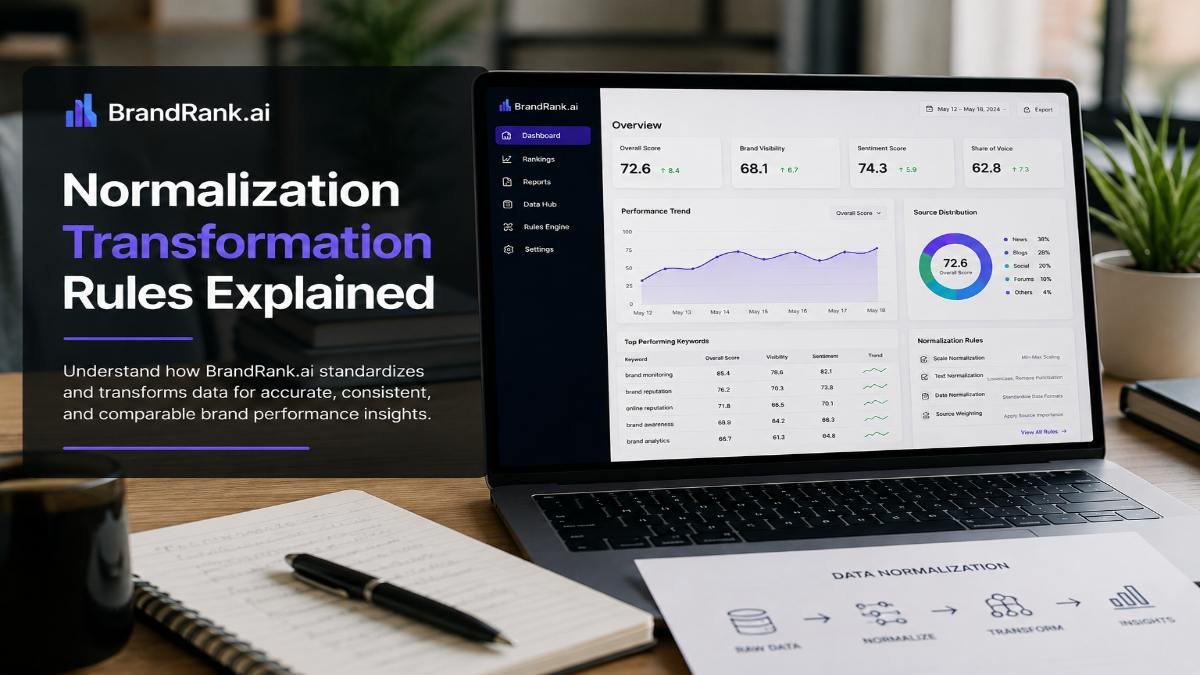
BrandRank.AI is a real AI brand-monitoring and recommendation platform, but its publicly available materials do not establish normalization transformation rules as a named, published technical specification. The company instead publicly describes capabilities such as AI Search Visibility, Brand Vulnerability, Content Readiness, Recommendation Share™, prompt monitoring, citation analysis, and brand-risk intelligence.
That does not make the phrase meaningless.
Normalization and transformation are established data practices. They are commonly used to clean inconsistent information, standardize representations, combine data from different sources, and prepare information for analysis. IBM, for example, describes data transformation as converting raw data into a unified structure and identifies normalization as one of the techniques used during data transformation.
So the useful way to understand this topic is to separate what BrandRank.AI publicly documents from what normalization and transformation generally mean in an AI-data context.
What Are BrandRank.ai Normalization Transformation Rules?
The phrase BrandRank.ai normalization transformation rules can be understood as a shorthand for the kinds of rules that could be used to make brand-related information consistent before it is analyzed.
However, it should not automatically be presented as an official BrandRank.AI technical framework.
In a general data workflow, normalization may turn different representations of the same entity into a consistent analytical form.
For example, imagine a company appears across different sources as:
- Example Technologies Inc.
- Example Technologies
- Example Tech
- EXAMPLE TECHNOLOGIES, INC.
- exampletechnologies.com
A data-processing system may need to determine which records refer to the same organization before calculating meaningful metrics.
Transformation then takes that cleaned information and converts it into the structure required by another system, database, report, or analytical process.
The distinction is simple:
Normalization creates consistency. Transformation creates compatibility or a new usable representation.
That distinction is useful when discussing AI search data because information may come from websites, reviews, news articles, product pages, directories, databases, and other sources.
Is Normalization Transformation Rules an Official BrandRank.AI Framework?
Based on the publicly available BrandRank.AI materials reviewed for this article, there is no public technical specification that defines a named “Normalization Transformation Rules” framework under that exact title.
BrandRank.AI publicly describes a different set of capabilities.
Its platform focuses on measuring how brands appear in AI-generated answers, whether they are recommended, what AI systems say about them, brand vulnerability, content readiness, and related signals. BrandRank also describes Recommendation Share™ as a measure of how often a brand is actually recommended across important category and buying questions.
This distinction matters.
A third-party article may describe a logical normalization process and attach the BrandRank.AI name to it. That does not prove that the process represents BrandRank.AI’s private algorithms, database schema, scoring formula, or proprietary rules.
Unless BrandRank.AI publicly documents a specific rule, it is safer to describe it as a general normalization or transformation practice, not as an officially confirmed internal BrandRank.AI rule.
What BrandRank.AI Actually Does
BrandRank.AI positions itself around the changing relationship between brands and AI answer engines.
Traditional search often gives users a list of pages. AI answer engines can instead produce a direct answer and recommend particular brands.
BrandRank.AI says its platform monitors important prompts across multiple answer engines and measures areas including AI Search Visibility, Brand Vulnerability, Content Readiness, and Recommendation Share™. Its current platform materials list ChatGPT, Gemini, Perplexity, Grok, Claude, Meta AI, and DeepSeek among the answer engines it tracks.
The platform also describes a process involving strategically important prompts, stronger evidence for important claims, content improvements, third-party authority, and repeated measurement after changes are published.
This provides useful context for understanding why consistent data matters, even though BrandRank.AI has not publicly published a technical document called normalization transformation rules.
Normalization vs. Transformation
The two terms are related, but they are not interchangeable.
What Is Normalization?
Normalization generally means bringing different representations into a consistent form.
For brand data, that might involve standardizing:
- capitalization
- spacing
- punctuation
- company-name variants
- domain formats
- product identifiers
- location names
- category labels
- duplicate records
For example:
Example Brand Inc.
Example Brand, Inc.
EXAMPLE BRAND INC
could potentially be standardized into one analytical representation.
The original brand name does not necessarily need to change publicly. The normalized value can simply be used internally for matching and analysis.
What Is Transformation?
Transformation goes a step further.
It changes information from one structure or format into another.
IBM describes data transformation as converting raw data into a unified format or structure so that it can be used by another system or analytical process.
For example, a raw record might contain:
Example Brand, Inc. | https://www.example.com/ | USA
A transformation could convert that into structured fields:
| Field | Value |
| Brand | Example Brand |
| Domain | example.com |
| Country | US |
| Entity Type | Company |
The transformed record becomes easier for another system to process.
Why Brand Data Needs Normalization
AI-related brand analysis can involve information from many different sources.
One source may use a company’s legal name. Another may use its consumer-facing brand name. A third may refer to a product instead of the parent company.
Without careful entity handling, those records can be difficult to compare.
Consider a fictional company called Northstar Coffee.
Its information could appear as:
- Northstar Coffee
- Northstar Coffee Co.
- NorthStar Coffee
- Northstar
- Northstar Coffee Roasters
- northstarcoffee.com
A person may understand the relationship immediately.
A data system needs explicit logic to determine whether these are:
- the same brand,
- different products,
- related companies,
- regional entities, or
- completely unrelated records.
That is where entity normalization and entity resolution become valuable.
Google Cloud’s guidance on preparing machine-learning data similarly emphasizes making data consistent and converting different representations of the same value into a common representation where appropriate.
Common Normalization Rules for Brand Data
There is no single universal rulebook for brand normalization. The correct rules depend on the dataset and the purpose of the analysis.
Still, several categories are commonly important.
1. Brand Name Normalization
A system may standardize obvious formatting differences.
For example:
Raw values
- ACME INC.
- Acme Inc.
- Acme, Inc.
- acme inc
Analytical value
- acme inc
This can make matching easier.
However, normalization should not blindly remove meaningful brand distinctions.
A company called ABC should not automatically be merged with every record containing the letters “ABC.”
Context matters.
2. URL and Domain Normalization
URLs can also appear in many forms:
- https://example.com
- http://example.com
- https://www.example.com/
- www.example.com
Depending on the analytical purpose, these may need to resolve to a common domain representation.
But URL normalization should be handled carefully because different subdomains and paths can represent genuinely different properties.
For example:
shop.example.com
may have a different purpose from:
support.example.com.
3. Product Normalization
Products create another major challenge.
A product might appear as:
- Product X
- Product X 500ml
- Product X 0.5L
- Product X Original
- Product X — Original Formula
A good system needs to determine which differences are meaningful and which are merely formatting variations.
Over-normalizing can be just as harmful as under-normalizing.
4. Location Normalization
Locations may have multiple representations.
For example:
- United States
- USA
- U.S.
- US
A system may map them to a common analytical value such as US.
The same concept can apply to states, cities, countries, and regional markets.
However, location should not be discarded when it affects the identity of a business or product.
5. Duplicate Detection
Duplicate records can distort analysis.
Suppose five websites contain slightly different records for the same brand. If a system counts them as five completely independent entities, its reporting may become misleading.
Deduplication attempts to determine when multiple records refer to the same underlying entity.
That process usually requires more than exact text matching.
6. Category Normalization
Different sources may use different category names.
One database might use:
Running Shoes
Another:
Athletic Footwear
Another:
Sports Shoes
These categories may overlap without being identical.
A transformation system can map them into a common taxonomy when the business purpose justifies doing so.
What Transformation Can Do With Normalized Data
Once data has been cleaned and standardized, it can be transformed into formats useful for analysis.
For example, raw AI-generated output could potentially be represented as structured fields such as:
| Raw Information | Possible Structured Field |
| Brand appears in answer | Mention |
| Brand is recommended | Recommendation |
| Competitor appears | Competitor |
| Source is cited | Citation |
| Answer discusses product quality | Topic |
| Answer contains a positive or negative statement | Sentiment |
| Claim conflicts with verified information | Accuracy/Risk flag |
These are examples of conceptual data transformations, not a claim about BrandRank.AI’s private implementation.
That distinction is essential.
A platform may use different fields, proprietary schemas, weighting systems, or analytical methods that are not publicly disclosed.
A Simple Example of Normalization and Transformation
Imagine an AI answer contains:
For home espresso, Example Coffee is often recommended, while Example Roasters is another option.
A simplified analytical workflow could look like this:
Step 1: Capture the raw answer
Keep the original response exactly as it was generated.
Step 2: Identify entities
Detect:
- Example Coffee
- Example Roasters
Step 3: Resolve entities
Determine whether each name corresponds to a known company, product, or unrelated term.
Step 4: Normalize names
Map verified variations to consistent analytical identifiers.
Step 5: Extract attributes
Identify:
- brands mentioned
- brands recommended
- category
- prompt
- answer engine
- citation information
Step 6: Transform the information
Convert the raw answer into structured records that can be compared over time.
Step 7: Analyze
Compare results across prompts, competitors, markets, or answer engines.
This general workflow demonstrates why normalization and transformation are useful without pretending that it is BrandRank.AI’s proprietary algorithm.
How Normalization Can Support AI Brand Analysis
Consistent data can improve the reliability of downstream analysis.
Suppose a company appears under three different names across a dataset.
If the system treats each version as a separate entity, the company’s visibility may appear fragmented.
If the system incorrectly combines two genuinely different companies, the opposite problem occurs: the results become artificially inflated.
Therefore, entity resolution is a critical analytical problem.
The objective is not simply to make everything look identical.
The objective is to preserve meaningful distinctions while making equivalent records comparable.
This principle applies well beyond AI search. Data transformation is also used for business intelligence, machine learning, data warehousing, data migration, and analytics.
What Normalization Cannot Guarantee
Normalization is useful, but it is not a magic solution for AI visibility.
Cleaning a company’s brand data does not automatically guarantee that:
- ChatGPT will recommend the company
- Google will rank the company higher
- an AI answer engine will cite a particular website
- a competitor will disappear from an answer
- a brand will receive a higher Recommendation Share
- an AI model will interpret every claim correctly
AI-generated answers depend on many signals and systems.
BrandRank.AI itself emphasizes that improving Recommendation Share involves more than data consistency. Its publicly described approach includes important prompts, evidence for claims, content gaps, third-party authority, publishing, verification, and repeated measurement.
Therefore, normalization should be viewed as data-quality infrastructure, not as a guaranteed ranking trick.
How Businesses Can Build a Reliable Normalization Process
Businesses that want cleaner brand data can start with a straightforward framework.
1. Create a Canonical Brand Record
Maintain a primary record containing:
- official brand name
- legal company name where relevant
- official domain
- important product names
- locations
- parent organization
- known brand aliases
2. Maintain an Alias List
Record legitimate variations.
For example:
| Type | Example |
| Official name | Example Coffee |
| Legal name | Example Coffee Holdings Inc. |
| Short name | Example |
| Domain | examplecoffee.com |
This makes future matching more reliable.
3. Keep Original and Normalized Values
Do not overwrite the raw data.
Store both:
Original: Example Coffee, Inc.
Normalized: example coffee inc
That preserves traceability.
4. Add Confidence Levels
Not every entity match is equally certain.
A system could distinguish:
- confirmed match
- probable match
- uncertain match
- rejected match
This is especially useful when similar company names exist.
5. Preserve Source Information
Keep track of where each record came from.
For AI brand analysis, useful metadata may include:
- source
- date
- market
- language
- URL
- prompt
- answer engine
- raw answer
- processing version
The exact fields will depend on the analytical system.
6. Test Transformation Rules
Google Cloud recommends automated data-quality testing and highlights checks such as missing values, incorrect values, duplicates, and problematic joins when preparing data for machine learning.
The same general principle applies to brand analytics:
A transformation rule should be tested against real examples before it is trusted.
Common Mistakes to Avoid
Treating a third-party description as official documentation
This is probably the biggest mistake surrounding this keyword.
If BrandRank.AI has not publicly documented a particular rule, don’t present it as an official proprietary rule.
Removing meaningful brand distinctions
A simple text-cleaning rule can accidentally merge different entities.
Destroying the original data
Always preserve the source value alongside the normalized value.
Applying the same rules everywhere
A rule suitable for company names may be inappropriate for product names or URLs.
Ignoring geographic context
Two businesses with similar names may operate in different countries or markets.
Assuming normalization equals optimization
Better data can improve analysis, but it does not guarantee better AI recommendations.
Why This Topic Matters for AI Search
AI search is changing how people discover products, companies, and information.
Instead of manually comparing several search results, users can ask an answer engine a direct question.
BrandRank.AI describes this shift around the idea that consumers increasingly receive a synthesized answer rather than a traditional list of pages. Its platform therefore focuses on whether brands are actually recommended, not merely mentioned. (brandrank.ai)
That makes trustworthy brand information increasingly important.
If a business has inconsistent names, outdated information, conflicting product details, or weak supporting evidence across its digital footprint, analyzing its AI visibility becomes more difficult.
Normalization does not solve all of those problems.
But it provides a foundation for making different records consistent, comparable, and easier to analyze.
The Bottom Line
The phrase brandrank.ai normalization transformation rules should be handled carefully.
BrandRank.AI is a real platform focused on AI brand visibility, vulnerability, content readiness, recommendation measurement, and related brand intelligence. However, its publicly available materials do not establish “normalization transformation rules” as an official named technical framework.
Normalization and transformation themselves are legitimate and well-established data practices.
Normalization helps bring equivalent information into a consistent representation.
Transformation converts information into a structure that another system can use.
For AI brand analysis, those principles can help organize brand names, products, domains, locations, citations, and other information. But businesses should distinguish between verified platform capabilities and reasonable interpretations based on general data-engineering practices.
That distinction is what makes the topic useful rather than speculative.
FAQs
Is BrandRank.ai normalization transformation rules an official BrandRank.AI feature?
There is no publicly available BrandRank.AI technical specification reviewed for this article that establishes that exact phrase as an official named feature or framework. BrandRank.AI publicly documents capabilities including AI Search Visibility, Brand Vulnerability, Content Readiness, and Recommendation Share™.
What does normalization mean in brand data?
Normalization means standardizing equivalent representations so they can be consistently matched or analyzed. For example, different formatting variations of a company name can potentially be mapped to a common analytical representation.
What is the difference between normalization and transformation?
Normalization primarily creates consistency between equivalent values. Transformation converts data from one structure or format into another structure suitable for a specific system or analysis. IBM describes transformation as converting raw data into a unified format or structure.
Can normalization improve AI search visibility?
Normalization can improve the quality and consistency of the data used for analysis, but it does not guarantee better AI search visibility or recommendations. AI visibility involves multiple factors, including content, sources, citations, competitive positioning, and the particular answer engine being evaluated.
Should businesses change their public brand name to match a normalized value?
No. A normalized analytical value is not necessarily the same thing as a brand’s public-facing name. Businesses should preserve their legitimate branding while using standardized representations internally when appropriate.
Why should original data be preserved?
Keeping the original value allows analysts to audit how a normalized record was created and correct mistakes later. It also reduces the risk of losing important information during automated processing.
Does BrandRank.AI publish its exact scoring or normalization formulas?
The public materials reviewed do not provide a complete technical specification of proprietary normalization formulas or scoring logic. BrandRank.AI does publicly describe its measurements and platform capabilities, including Recommendation Share™ and Content Readiness.